- ProductSoftle
- ProductFloat.com - Finance and Ops Dashboard
- ProductFloat.com - Design system
- ProductFloat.com - Onboarding
- ProductAmerican Student Assistance - ASA Futurescape
- InteractiveTony's Chocolonely - Tony's Chocolonely FAIRground
- InteractiveMaserati - The House of Maserati
- InteractiveNike - Nike Air Hub
- InteractiveLufthansa - Lufthansa #SayYesToTheWorld
- InteractiveLufthansa - Lufthansa #LifeChangingPlaces
- InteractiveCorvette - Corvette ZR1 Interactive Modules
- InteractiveAirbnb - Airbnb — Family Trips
- InteractiveSyFy - The Magicians II — Welcome to Fillory
- InteractiveUbisoft - Assassin's Creed IV — Black Flag
- InteractiveDisney - Find Your Way to Oz
- InteractiveGoogle - Arcade Fire — Just a Reflektor
- CampaignControl - Control Orgasmatic
- InteractiveOptimus - Optimus “O que nos liga”
ASA Futurescape
Tech Lead
- Client
- American Student Assistance
- Studio
- UNIT9
- Year
- 2020
Futurescape helped students in the US, from middle school to the end of high school, find work that might suit them. A short quiz read their interests, then opened a galaxy of nearly a thousand jobs, grouped into industries and fields, each job a planet with what it paid and what it took to get there.
I led the front end from the first commit to launch in May 2020, and owned the systems the app ran on: the galaxy, the framework under it, the quiz scoring and the charts on each job.
The quiz was built on Holland Codes, which sort interests into six types: realistic, investigative, artistic, social, enterprising and conventional. Each answer scored some of them, and the three highest made the student's code.
Ties were common, so the last question asked students to drag a set of abilities into order, and that order settled them. To trust the scoring, I wrote a tool that ran every possible set of answers in a Web Worker and listed the code each one reached.
The galaxy ran on my own engine, built on PIXI.js and WebGL. A d3-force simulation placed the planets without drawing anything, and a camera on springs moved over a world 3500 by 2000 pixels wide.
The links between planets were curves with a spring at their midpoint, so they bowed as planets moved. Each halo was drawn once into a shared texture and reused as a tinted sprite, and anything off screen was left out with a spatial hash.
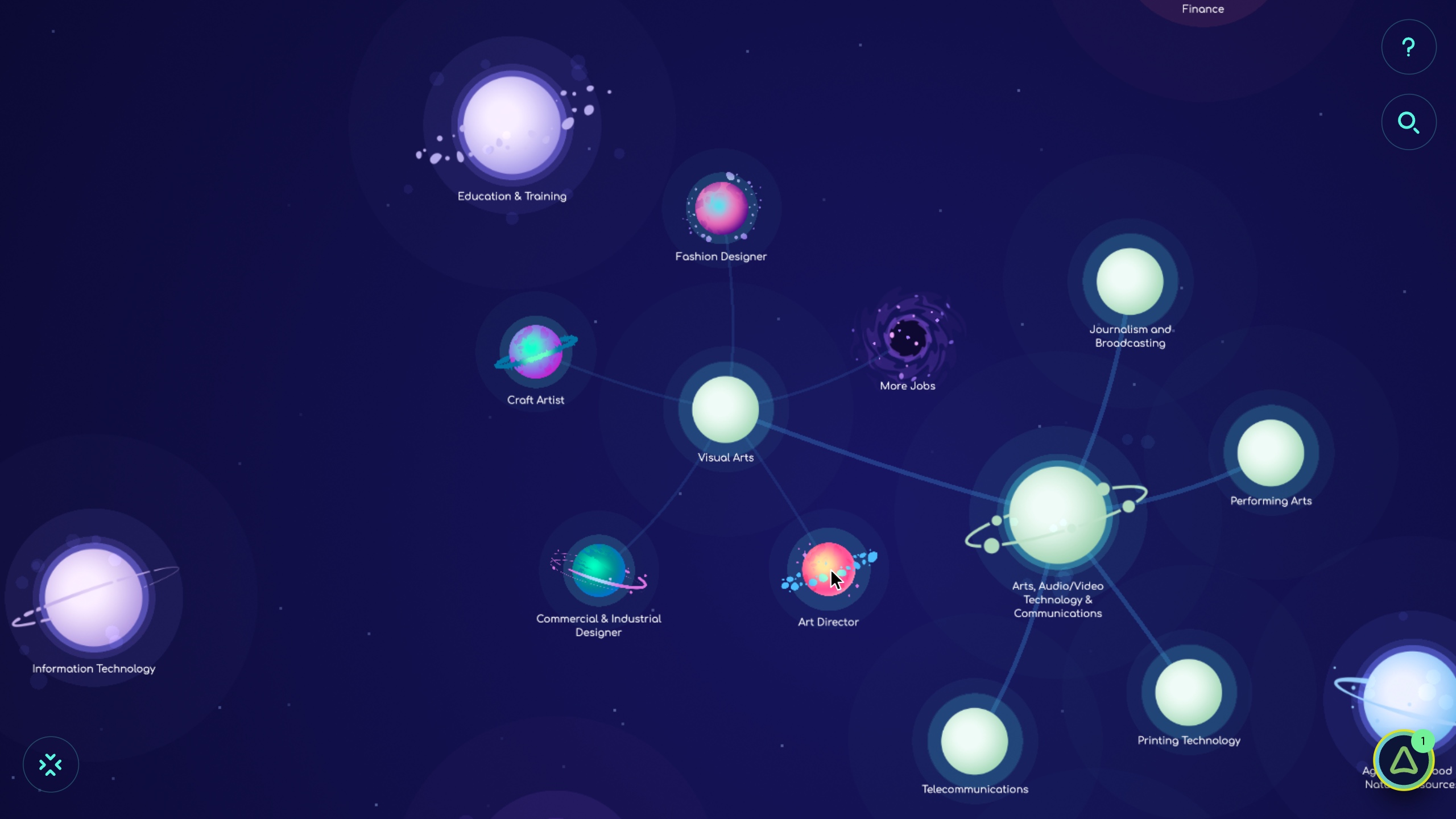
No job had its own artwork. A seeded random generator combined 20 surfaces, 20 orbits and 10 extras into 1,000 planets, and each job always drew the same one.
Underneath sat a small framework I wrote for the app: a shared ticker, preloader, sound and network services, and a Webpack build that loaded GLSL shaders. It shipped as a PWA, with each route loaded on demand.
Futurescape was featured on FWA.
Built with React, Redux, PIXI.js, d3 and GLSL.